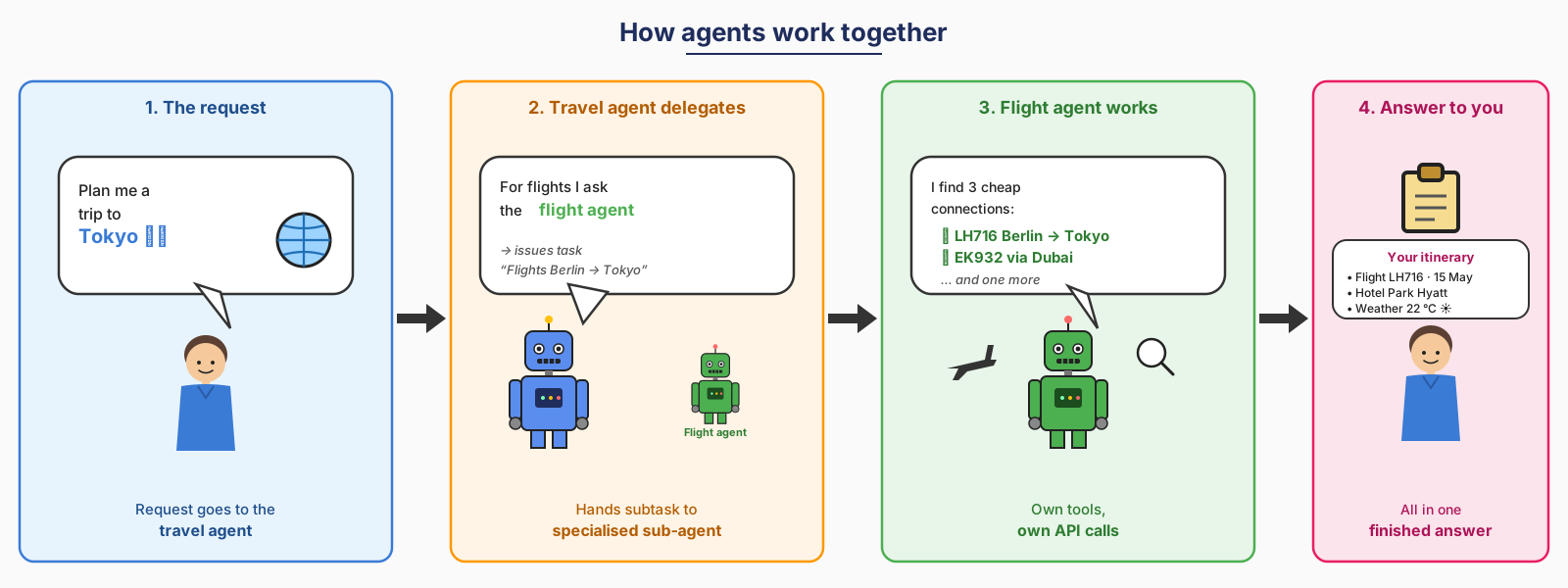
How sub-agents work
The model picks a sub-agent through a tool call:
run_agent("web-researcher", "Research Qdrant")
An agent can call the agents its callableAgents roster names, and no
others: the roster is what gives it run_agent, run_agents and
list_agents in the first place, and an agent without one has none of them.
Agents marked callableByAgents: false — the runtime's own helpers, like the
title generator — are never callable, whatever a roster says.
The sub-agent runs in its own session — own prompt, tools and model — does its work, and returns the result. Sub-agents can call sub-agents recursively, up to a depth of 5; each sub-agent call times out after 2 hours.

Agents a project brings with it
A registry every project shares is the wrong place for a reviewer that knows
this codebase's rules. Those agents live beside the code, in
.mindconnect/agents/ in the session's working directory, one Markdown file
each:
---
name: verifier
description: Checks that a change really builds and its tests pass
tools: bash, file_read, grep
model: claude-haiku-default
---
You verify. Run the build and the tests, then say what you ran and what came
back. Never report success you have not seen.
Everything above the body is optional: without name the file name is the
name, without model it runs on the caller's, without tools it keeps the
caller's own — while tools: [] keeps none. The body is the system prompt.
tools and disallowedTools take either form, a comma list or an indented
block:
tools:
  - bash
  - file_read
run_agent finds them by name,
list_agents shows them first, and a project agent shadows a registered one
of the same name for that session.
They are read from the directory each time a call resolves one, so an edit lands on the next call. A sub-agent already running keeps the definition it started with.
Its tools are the caller's own, narrowed: disallowedTools takes some
away, tools keeps the ones it names, and naming a tool the caller does not
have grants nothing. Each tool keeps the approval the caller's binding gives
it, so a project cannot wave bash through. A tool the caller left to tool
search stays deferred, and tool search only ever finds those, so it cannot
look further tools up either.
That is what makes opening someone else's repository safe: the file can only
narrow what the agent calling it was already allowed to do. It is not subject
to the caller's callableAgents roster, though — that roster curates the
registry, and this agent comes from the same directory whose instructions the
caller is already following. What it calls in turn is: it inherits the
caller's roster along with its tools, so an agent limited to two others cannot
reach a third by way of a file in the repository.
Why delegate?
- Decompose complex tasks into focused sub-tasks.
- Parallelism — several sub-agents work at once.
- Specialization — each sub-agent has a tailored prompt and toolset.
- Smaller main context — the orchestrator only sees results, not every intermediate tool call.
The call as a comic
A travel agent delegating flight search to a specialized sub-agent — the same
shape as research-lead calling web-researcher: